
PAS 108 Tyre Bales Gain Traction in Civil Engineering and Construction Projects
PAS 108 Tyre Bales Gain Traction in Civil Engineering and Construction Projects by gradeall.com
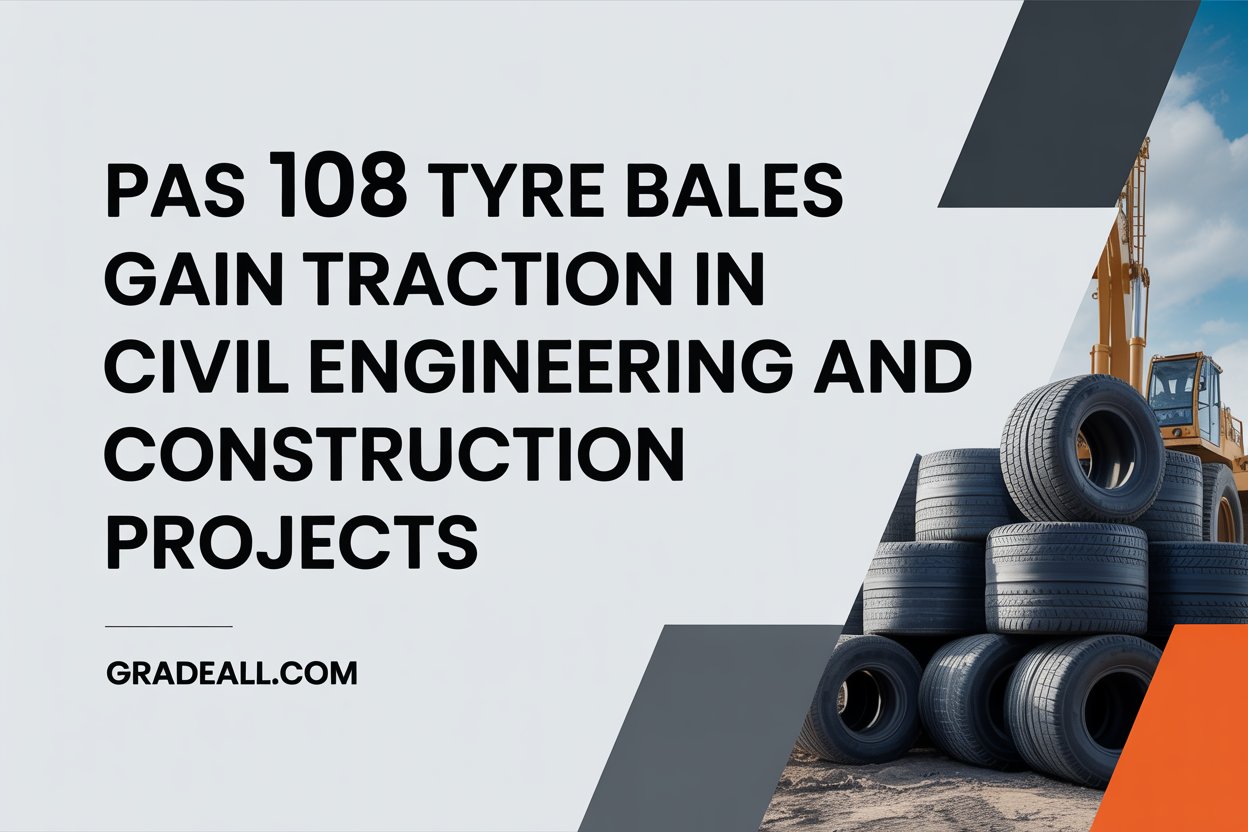
PAS 108 Tyre Bales Gain Traction in Civil Engineering and Construction Projects - gradeall.com
PAS 108 Tyre Bales Gain Traction in Civil Engineering and Construction - gradeall.com
PAS 108 Tyre Bales Gain Traction in Civil Engineering and Construction
British Standards Institution specification transforms end-of-life tyres into construction material for road foundations, slope repairs and drainage systems.
Developed by the British Standards Institution in collaboration with WRAP (Waste & Resources Action Programme), PAS 108 establishes specifications for producing compact tyre bales of consistent and verifiable quality. These standardised bales can be used in civil engineering applications including road foundations over soft ground, slope failure repairs, lightweight embankment fill, and free-draining layers behind retaining walls.
With approximately 600,000 tonnes of end-of-life tyres generated in the UK annually and growing pressure to develop circular economy solutions, PAS 108-compliant tyre bales offer construction specifiers a sustainable option that diverts waste from export whilst delivering genuine engineering performance.
"PAS 108 compliance isn't just about waste diversion - it's about providing construction professionals with a material they can specify with confidence," says Conor Murphy of Gradeall International, a Northern Ireland-based manufacturer of PAS 108-compliant tyre baling equipment. "The standard defines exact dimensions, weight tolerances, and engineering properties, so specifiers know precisely what they're getting."
What is PAS 108 and How Was It Developed
PAS 108 was prepared by the British Standards Institution following extensive consultation with stakeholders from the secondary tyre industry, construction sector, and waste management professionals. The specification was developed to address a recognised need: whilst tyre bales had demonstrated potential in construction applications, the absence of standardised specifications created uncertainty for specifiers and limited adoption.
The Publicly Available Specification establishes requirements across the entire tyre bale lifecycle, from input materials through production processes to final placement in construction works. This comprehensive approach ensures that bales meeting the standard deliver consistent, predictable performance in engineering applications.
WRAP, the Waste & Resources Action Programme, played a central role in developing PAS 108 as part of broader efforts to find beneficial uses for end-of-life tyres. The organisation recognised that construction applications could absorb significant volumes of waste tyres whilst delivering genuine utility, but that market development required standardisation to build specifier confidence.
The specification was written by Jonathan Simm of HR Wallingford and Dr Mike Winter of TRL Limited, working in collaboration with WRAP, BSI, and a steering group of specialists drawn from tyre baling, construction, and related industries. This expert input ensured the standard reflects both practical production realities and rigorous engineering requirements.
PAS 108 Tyre Bale Specifications and Dimensions
The engineering properties specified in PAS 108 enable construction professionals to design with tyre bales using documented, verified characteristics rather than estimates or assumptions. Understanding these specifications helps explain why PAS 108 compliance matters for construction applications.
Reference bales produced to PAS 108 measure 1.33 metres in length (with tolerance of +0.08m/-0.06m), 1.55 metres in width (±0.07m), and 0.83 metres in depth (±0.04m). These dimensions create bales with a volume of approximately 1.70 cubic metres, large enough to be practical for construction use whilst remaining manageable for transport and placement.
Each reference bale weighs approximately 810 kg (±35 kg), giving a nominal mass density of 470 kg/m³. This density is significantly lower than conventional aggregate materials, which typically range from 1,400 to 2,000 kg/m³ depending on type. The low density makes tyre bales particularly valuable for applications where weight reduction matters, such as construction over soft ground or lightweight embankment fill.
The specification also permits production of alternative bale sizes for specialist applications. Reduced length bales (minimum 0.6m), reduced width bales (approximately 1.15m), and increased width bales (approximately 1.95m) can be produced where specific project requirements dictate. However, reference width bales are encouraged for most applications as they represent the standard output of commercially available baling equipment.
Bales are secured with galvanised steel tie wires - five wires for reference bales, with wire lengths of approximately 3.5 metres. The wire specification ensures bales maintain their compressed form throughout handling, transport, and placement, and during their service life within construction works.
Engineering Properties of PAS 108 Tyre Bales
Beyond dimensional specifications, PAS 108 documents the engineering properties that enable design use of tyre bales in construction applications. These properties have been established through testing programmes and field monitoring of installed bale structures.
The true mass density of PAS 108 bales is approximately 500 kg/m³, with porosity of around 62%. This high porosity makes tyre bales exceptionally permeable - permeability through the depth of bales ranges from 0.1 to 0.2 metres per second, comparable to clean gravel. This permeability proves particularly valuable in drainage applications and for construction over waterlogged ground.
Shear strength testing indicates an inter-bale friction angle of 35° to 36° for dry bales, with negligible cohesion. This frictional response enables bale structures to resist lateral loads and provides stability in slope applications.
Stiffness, expressed as Young's Modulus, ranges from 800 to 1,000 MPa depending on degree of confinement. These values increase within the range as confinement increases, meaning bales become stiffer when loaded within a constrained structure - a beneficial characteristic for many construction applications.
Long-term creep monitoring at installations including beach protection works at Pevensey has demonstrated total creep of up to 1.1% over 35 months, with measurements indicating the creep process has substantially slowed and long-term creep is not expected to exceed 1.5%. This limited creep confirms that tyre bale structures remain dimensionally stable over extended service periods.
Construction Applications for PAS 108 Tyre Bales
The engineering properties of PAS 108 tyre bales suit several civil engineering applications where their unique characteristics provide advantages over conventional materials.
Road foundations over soft ground represent a significant application opportunity. The low density of tyre bales reduces loading on underlying soft soils compared to conventional aggregate foundations. High permeability allows water to drain freely, preventing the build-up of pore water pressure that can cause foundation problems. Several trial installations have demonstrated successful performance in this application.
Slope failure repairs utilise tyre bales to reconstruct failed embankments and cuttings. The lightweight nature of bales reduces driving forces on slip surfaces compared to conventional fill materials. Permeability ensures water drains freely from within the repaired slope, addressing one of the primary causes of slope instability. Bales can be placed relatively quickly compared to conventional earthworks, reducing disruption during repair works.
Lightweight embankment fill applications exploit the low density of tyre bales to reduce total embankment weight. This proves valuable where embankments must be constructed over compressible ground, where bridge abutments require reduced loading on foundations, or where existing structures have limited load-bearing capacity.
Free-draining layers behind retaining walls benefit from the exceptional permeability of tyre bales. Conventional guidance requires drainage layers behind retaining walls to prevent water pressure build-up that increases loads on the wall structure. Tyre bales provide drainage capacity far exceeding minimum requirements whilst also reducing the weight of backfill material.
Drainage layers in various applications including landfill engineering exploit the permeability and porosity of tyre bales. Sustainable urban drainage systems (SUDS) can incorporate tyre bales as storage and infiltration elements within drainage designs.
Why Bale Tyres for Construction Use
The question of why tyres should be baled rather than processed through alternative routes reflects broader considerations about optimal end-of-life tyre management and the particular advantages of construction applications.
Baling preserves the structural integrity of tyres whilst dramatically reducing volume - typically by 80% compared to loose tyres. This volume reduction transforms a bulky, difficult-to-handle waste stream into uniform, stackable units that can be efficiently transported, stored, and placed. A single PAS 108 bale contains approximately 100 car tyres compressed into a unit weighing around 810 kg.
Construction use of tyre bales represents genuine material recovery rather than energy recovery or disposal. The tyres remain intact within the bale structure, performing a useful function for the design life of the construction works - potentially many decades for permanent infrastructure. This aligns with circular economy principles that prioritise keeping materials in productive use.
The construction sector consumes enormous quantities of aggregate materials annually, creating significant environmental impacts through quarrying, processing, and transport. Tyre bales can substitute for aggregates in appropriate applications, reducing demand for virgin materials whilst providing a beneficial use for waste tyres.
From an economic perspective, tyre bales can prove cost-competitive with conventional materials when full project costs are considered. The lightweight nature reduces transport costs per unit volume, placement can be faster than conventional earthworks, and waste disposal costs are avoided. Project-specific analysis determines whether tyre bales offer economic advantages for particular applications.
Equipment for Producing PAS 108 Compliant Bales
Producing bales that meet PAS 108 specifications requires purpose-designed equipment capable of achieving the compression forces, dimensional control, and wire binding quality specified in the standard. Not all tyre baling equipment produces PAS 108-compliant output.
Gradeall International's MKII Tyre Baler has been specifically designed to produce PAS 108-compliant bales consistently. The machine delivers compression forces exceeding 85 tonnes, sufficient to achieve the density specifications required by the standard. Double rows of bale retainers positioned where bale wires are placed facilitate accurate wire positioning and secure tying.
The baler produces between four and six PAS 108-compliant bales per hour, with each bale containing approximately 100 tyres depending on tyre size and type. This production rate enables efficient processing of significant tyre volumes whilst maintaining the quality control necessary for standard compliance.
Custom-designed power units reduce power consumption and noise levels whilst providing the hydraulic pressure required for consistent compression. The robust construction reflects nearly 40 years of manufacturing experience and feedback from installations worldwide.
For operations requiring higher throughput, the Inclined Tyre Baler Conveyor integrates with MKII Balers to process up to 850 tyres per hour. The conveyor brings tyres to operators at chest height, reducing physical strain whilst significantly increasing productivity. This combination suits facilities processing large volumes for construction supply contracts.
The MK3 Tyre Baler offers enhanced capacity for industrial-scale operations, producing bales 50% larger than standard PAS 108 specifications. Whilst these larger bales fall outside standard PAS 108 dimensions, they may suit specific project requirements where larger unit sizes prove advantageous.
Quality Control and Factory Production Control
PAS 108 includes requirements for factory production control procedures that ensure consistent bale quality. Processors seeking to supply construction markets must implement quality management systems that verify compliance with specification requirements.
Input control requirements address the receipt, inspection, cleaning, handling, and storage of tyres intended for incorporation into bales. Tyres must be suitable for baling - excessively damaged tyres or those contaminated with incompatible materials should be excluded.
Process control covers the compression and baling operation itself, including monitoring of compression force, wire tensioning, and dimensional verification. Consistent machine setup and operation ensures bales meet dimensional and weight specifications.
Output verification includes measurement of bale dimensions and weight to confirm compliance with tolerances specified in the standard. Records of production and quality verification provide traceability and evidence of compliance.
Storage and handling procedures ensure bales maintain their quality between production and delivery. Proper stacking, protection from damage, and inventory management support quality preservation.
Processors supplying construction projects may need to demonstrate their quality management systems to specifiers and contractors. PAS 108 provides a framework that enables this demonstration and builds confidence in the supply chain.
Regulatory Position of Tyre Bales in Construction
The regulatory position of tyre bales in construction has evolved as experience has accumulated and the benefits of beneficial use have become recognised. Understanding current regulatory frameworks helps processors and specifiers navigate compliance requirements.
The specific use of tyre bales in construction, once manufactured to appropriate standards, is generally accepted by waste regulators in the UK as a low-risk activity. Regulators have not actively pursued licensing applications for the use of tyre bales in construction, recognising that this represents beneficial use rather than waste disposal.
PAS 108 notes that future amendments to regulations may introduce specific exemptions to cover tyre bale use in construction, providing explicit regulatory clarity. The direction of regulatory development has generally supported beneficial uses of waste materials that demonstrate genuine utility.
Environmental permitting requirements apply to tyre baling operations themselves, which involve waste processing activities. Operators must hold appropriate permits or exemptions for their processing activities, separate from any requirements relating to end use of produced bales.
Construction projects incorporating tyre bales should ensure appropriate design verification, typically involving geotechnical engineers with relevant experience. Whilst PAS 108 provides material specifications, project-specific design remains the responsibility of the project team.
Market Development and Future Outlook
The market for PAS 108 tyre bales in construction applications continues to develop as awareness grows among specifiers and successful case studies accumulate. Several factors support continued market development.
Circular economy policy increasingly favours beneficial use of waste materials over disposal or energy recovery. Government procurement guidance encourages consideration of recycled and secondary materials in construction projects. These policy drivers create a supportive environment for tyre bale specification.
Carbon reduction targets are driving construction clients to examine the embodied carbon of materials specified in their projects. Tyre bales offer carbon benefits compared to virgin aggregates, particularly when transport distances are considered. Life cycle assessment increasingly informs material selection decisions.
Cost pressures in construction create interest in alternative materials that can deliver equivalent performance at competitive cost. Tyre bales can prove economically attractive for appropriate applications, particularly where their lightweight nature reduces foundation costs or transport requirements.
Growing volumes of end-of-life tyres require expanded processing and end-use capacity. Parliamentary debate in 2025 highlighted that domestic tyre processing could generate £250 million annually for the UK economy. Construction applications represent one outlet for increased domestic processing capacity.
Equipment manufacturers continue to refine baling technology to improve efficiency, consistency, and output quality. Investment in modern equipment enables processors to supply construction markets with confidence in product quality and production economics.
FREQUENTLY ASKED QUESTIONS
What is PAS 108?
PAS 108 is a Publicly Available Specification developed by the British Standards Institution in collaboration with WRAP. It provides specifications for producing compact tyre bales of consistent and verifiable quality for use in construction applications. The standard defines bale dimensions, weight tolerances, engineering properties, and quality control requirements.
What are PAS 108 tyre bale dimensions?
Reference bales measure 1.33 metres in length, 1.55 metres in width, and 0.83 metres in depth. Each bale weighs approximately 810 kg and contains around 100 compressed car tyres. Alternative sizes can be produced for specialist applications.
What construction applications can use tyre bales?
PAS 108 tyre bales suit applications including road foundations over soft ground, slope failure repairs, lightweight embankment fill, free-draining layers behind retaining walls, drainage layers, and sustainable urban drainage systems. Their low density and high permeability provide advantages over conventional materials in these applications.
Why are tyre bales lightweight compared to aggregates?
PAS 108 tyre bales have a nominal mass density of 470 kg/m³, compared to 1,400-2,000 kg/m³ for conventional aggregates. This low density results from the high porosity (approximately 62%) of compressed tyre bales. The lightweight nature reduces loading on soft ground and foundations.
Conor Murphy
Gradeall International Limited
email us here
Visit us on social media:
LinkedIn
Facebook
YouTube
X
Other
Gradeall MKII Tyre Baler - Baling car tyres| Recycle Tyres/Tires | Recycling Baler Machines
Legal Disclaimer:
EIN Presswire provides this news content "as is" without warranty of any kind. We do not accept any responsibility or liability for the accuracy, content, images, videos, licenses, completeness, legality, or reliability of the information contained in this article. If you have any complaints or copyright issues related to this article, kindly contact the author above.
